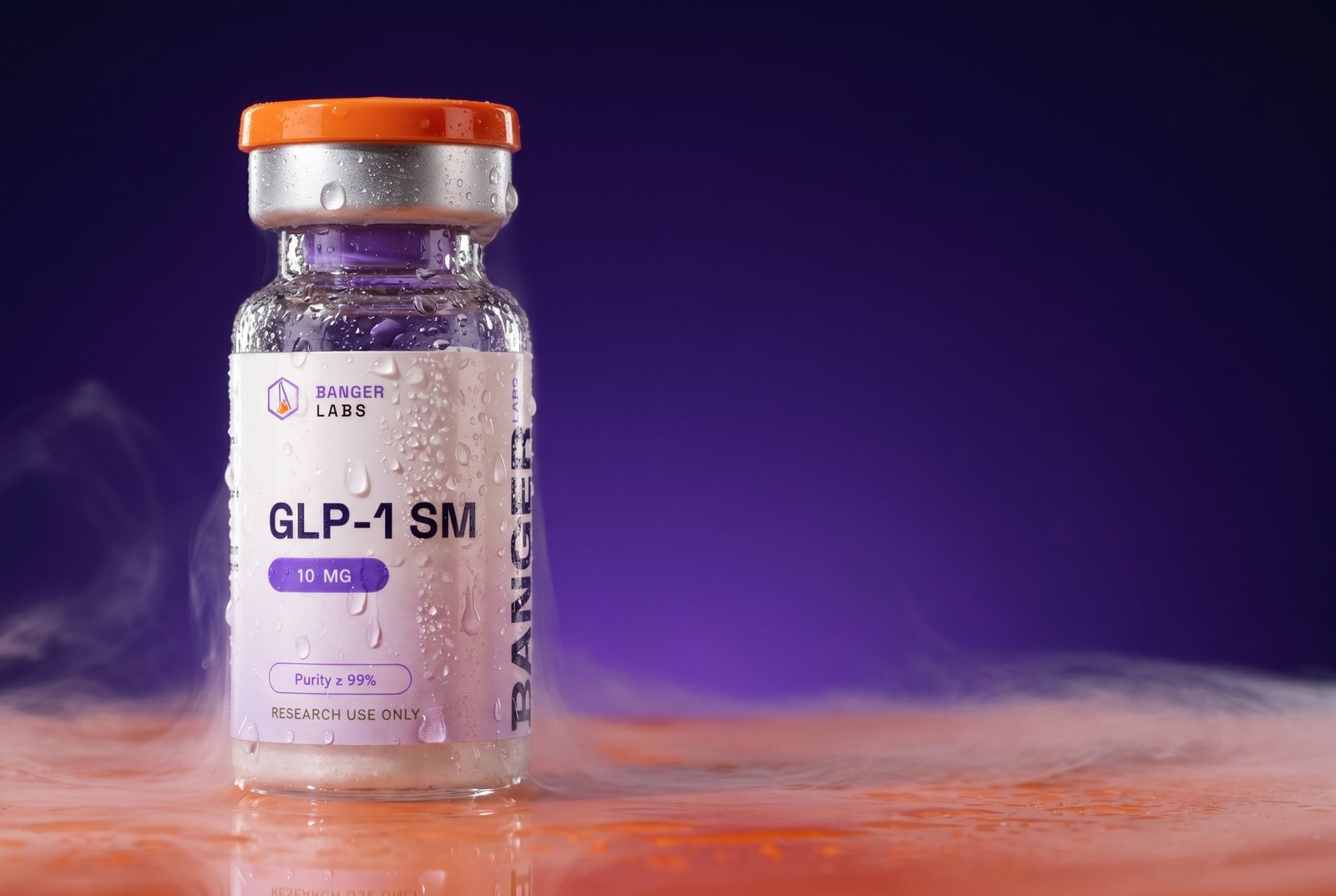
GLP-1 SM and GLP-2 T are frequently grouped together as incretin-mimetic research peptides, but at the receptor level they are not the same class of molecule. GLP-1 SM is a mono-agonist acting at the GLP-1 receptor; GLP-2 T is a dual agonist engineered to activate both the GLP-1 and GIP receptors from a single peptide backbone. This guide compares the two strictly at the level of receptor pharmacology and the preclinical/in-vitro literature. Both peptides are sold for laboratory research use only and are not for human consumption, diagnostic use, or therapeutic application.
Two molecules, two receptor strategies
The core difference is the number of incretin receptors each peptide engages. The incretin system — named for hormones that potentiate glucose-stimulated insulin secretion — is built on two native peptides: glucagon-like peptide-1 (GLP-1) and glucose-dependent insulinotropic polypeptide (GIP). GLP-1 SM engages only the first; GLP-2 T is designed to engage both.
GLP-1 SM is a GLP-1 receptor agonist derived from the native GLP-1 sequence, with amino-acid substitutions and a fatty-acid (C18 diacid) side chain that, in published pharmacokinetic studies, slows degradation and extends half-life relative to native GLP-1. Mechanistically it is a single-target agonist: GLP-1 receptor only.
GLP-2 T is a synthetic 39-amino-acid peptide based on the GIP sequence and engineered to bind both the GIP and GLP-1 receptors. It is the most-studied example of the dual incretin (GIP/GLP-1) co-agonist design class in the peer-reviewed literature.
Receptor targets at a glance
The cleanest way to separate these two peptides is by their receptor profile and what the preclinical literature attributes to each receptor arm. The table below summarizes the established, non-fabricated distinctions.
| Attribute | GLP-1 SM | GLP-2 T |
|---|---|---|
| Class | GLP-1 receptor mono-agonist | GIP/GLP-1 receptor dual agonist |
| Receptor targets | GLP-1R | GIP-R + GLP-1R |
| Backbone origin | GLP-1-derived sequence | GIP-derived sequence (engineered for dual binding) |
| Half-life extension | C18 fatty-acid diacid acylation (albumin binding) | C20 fatty-acid acylation (albumin binding) |
| Primary preclinical readouts | Glucose-dependent insulin secretion, gastric emptying, food-intake reduction in animal models | Glucose-dependent insulin secretion via two receptor arms; metabolic readouts in animal models |
| Mono vs dual | Mono (single incretin receptor) | Dual (two incretin receptors) |
| Research status | Research-use-only peptide | Research-use-only peptide |
For a broader map of where both molecules sit relative to other incretin and gut-hormone peptides, see the companion overview, GLP-1 class research peptides explained.
GLP-1 receptor biology (the shared arm)
Both peptides activate the GLP-1 receptor, a class B G-protein-coupled receptor expressed in pancreatic islet cells and several other tissues. In the preclinical literature, GLP-1 receptor activation is associated with glucose-dependent potentiation of insulin secretion — meaning the insulinotropic effect observed in models is conditional on elevated glucose rather than constitutive.
Established GLP-1R-linked readouts in animal/in-vitro models
- Glucose-dependent insulinotropic signaling in isolated islet and beta-cell preparations.
- Slowed gastric emptying in animal models.
- Reduced food intake in rodent feeding studies.
- Central appetite-circuit activity reported in animal central-nervous-system studies.
Because GLP-1 SM acts only here, its preclinical pharmacology is essentially the pharmacology of sustained GLP-1 receptor agonism. This is the single most characterized arm shared by the two molecules.
The GIP arm: what makes GLP-2 T distinct
GLP-2 T adds activation of the GIP receptor, the second incretin GPCR. GIP is the other major incretin hormone, and its receptor is expressed in islet tissue, adipose tissue, and parts of the central nervous system in published animal work. The scientific rationale for a dual agonist is that co-stimulating GIP-R and GLP-1R may engage complementary metabolic pathways rather than relying on a single incretin axis.
It is important to be precise here: the relative contribution of the GIP arm to the overall metabolic profile of GLP-2 T is an active area of research, and the published mechanistic picture continues to develop. GLP-2 T also shows a degree of signaling bias at the GLP-1 receptor in receptor-pharmacology studies, meaning its engagement of GLP-1R is not identical to that of GLP-1-native agonists like GLP-1 SM.
Preclinical metabolic research
In animal and in-vitro metabolic studies, both peptides are investigated as tools for probing incretin signaling, glucose handling, and energy-balance circuits. The mono- versus dual-agonist contrast is exactly why researchers study them side by side: GLP-1 SM isolates the GLP-1 axis, while GLP-2 T allows comparison of single- versus combined-incretin-receptor stimulation.
- Insulin secretion assays — both are used to study glucose-dependent insulinotropic responses in islet and beta-cell systems.
- Receptor pharmacology — binding, cAMP accumulation, and signaling-bias assays distinguish mono- from dual-agonist behavior.
- Animal energy-balance models — feeding and body-weight readouts in rodents are common endpoints in the published literature for both molecules.
- Comparative co-agonist studies — GLP-2 T is a reference compound for the broader unimolecular multi-agonist research program.
These are research observations in non-human systems. They are not evidence of, and must not be read as, human therapeutic effects, weight-loss outcomes, or treatment of any condition.
Forms, handling, and purity for research
Both peptides are supplied as lyophilized powder for reconstitution in the laboratory. Handling considerations are similar across the two, since both are acylated peptides sensitive to repeated freeze-thaw and prolonged warm storage.
- Verify identity and purity against a certificate of analysis before use — see how to read a peptide COA.
- Follow standard peptide reconstitution and storage practice: bacteriostatic or sterile diluent, gentle handling, cold storage, minimal freeze-thaw cycling.
- Keep lyophilized material cold and protected from light and moisture until reconstitution.
- Treat the two as distinct analytes — they are different sequences with different molecular weights, so reconstitution math is not interchangeable.
Product pages: GLP-1 SM and GLP-2 T. Both sit within the receptor agonists research category, alongside related incretin and gut-hormone peptides such as GLP-3 R and GLP-5 C for comparative work.
Choosing between them for a study
The decision is a mechanistic one, not a ‘which is stronger’ one. Select based on which receptor question the experiment is designed to answer.
- If the goal is to isolate GLP-1 receptor pharmacology, GLP-1 SM is the cleaner single-target probe.
- If the goal is to study combined GIP/GLP-1 signaling or to use a reference dual agonist, GLP-2 T is the established tool.
- For class-level context across more than two molecules, pair either with the broader incretin-peptide overview before designing comparative assays.
Mono-agonist versus dual-agonist is the defining distinction — everything else follows from how many incretin receptors the molecule engages.
Common questions
What is the fundamental difference between GLP-1 SM and GLP-2 T?
GLP-1 SM is a GLP-1 receptor mono-agonist — it activates one incretin receptor. GLP-2 T is a GIP/GLP-1 dual agonist — a single peptide engineered to activate two incretin receptors. That mono-versus-dual receptor distinction is the core difference and drives most of the comparison. Both are research-use-only peptides, not for human use.
Does the GIP arm make GLP-2 T ‘better’ than GLP-1 SM?
The literature does not support a simple ‘better’ framing. GLP-2 T adds GIP receptor activation, and the relative contribution of that arm is an active research question. For laboratory work the right framing is which receptor question you are studying — single-axis (GLP-1) versus combined-axis (GIP/GLP-1) — not a ranking of potency.
Are these molecules the same sequence with a different name?
No. They are different peptides with different backbones, sequences, and molecular weights. GLP-1 SM is derived from the GLP-1 sequence; GLP-2 T is based on a GIP sequence engineered for dual binding. Reconstitution calculations are not interchangeable between them — treat each as a distinct analyte and verify against its own COA.
Why study a mono-agonist and a dual agonist side by side?
Running them in parallel lets researchers separate the GLP-1 axis (isolated by GLP-1 SM) from the combined GIP/GLP-1 axis (represented by GLP-2 T). It is a standard comparative design in incretin receptor pharmacology and animal metabolic studies.
Can I use these peptides for weight loss or treatment?
No. These materials are sold strictly for in-vitro and laboratory research use only. They are not for human consumption, not therapeutic agents, and nothing on this page is a dosing protocol or a medical claim. See our research disclaimer for the full terms.
Related research reading
References
- Nauck MA, Quast DR, Wefers J, Meier JJ. GLP-1 receptor agonists in the treatment of type 2 diabetes — state-of-the-art. Molecular Metabolism. 2021 (review of GLP-1 receptor agonist pharmacology).
- Coskun T, et al. LY3298176, a novel dual GIP and GLP-1 receptor agonist (GLP-2 T): preclinical characterization. Molecular Metabolism. 2018 (primary preclinical pharmacology of the dual agonist).
- Willard FS, et al. GLP-2 T is an imbalanced and biased dual GIP and GLP-1 receptor agonist. JCI Insight. 2020 (receptor signaling-bias characterization).
- NCBI PubChem — compound records for GLP-1 SM and GLP-2 T (structures and molecular data): https://pubchem.ncbi.nlm.nih.gov/
Banger Labs supplies materials for laboratory and research use only. Not for human consumption. Not intended to diagnose, treat, cure, or prevent any disease. Statements have not been evaluated by the FDA.
Shop research peptides
Research-grade, ≥ 99% HPLC standard, COA per batch:



- BPC-157 vs TB-500: Research Comparison →
- CJC-1295 vs Ipamorelin: Research Comparison →
- GHRP-2 vs GHRP-6 vs Ipamorelin vs Hexarelin: Growth-Hormone Secretagogue Comparison →
Browse the full Research Library →
For research use only. Not for human or veterinary use. Not a drug, food, or cosmetic.